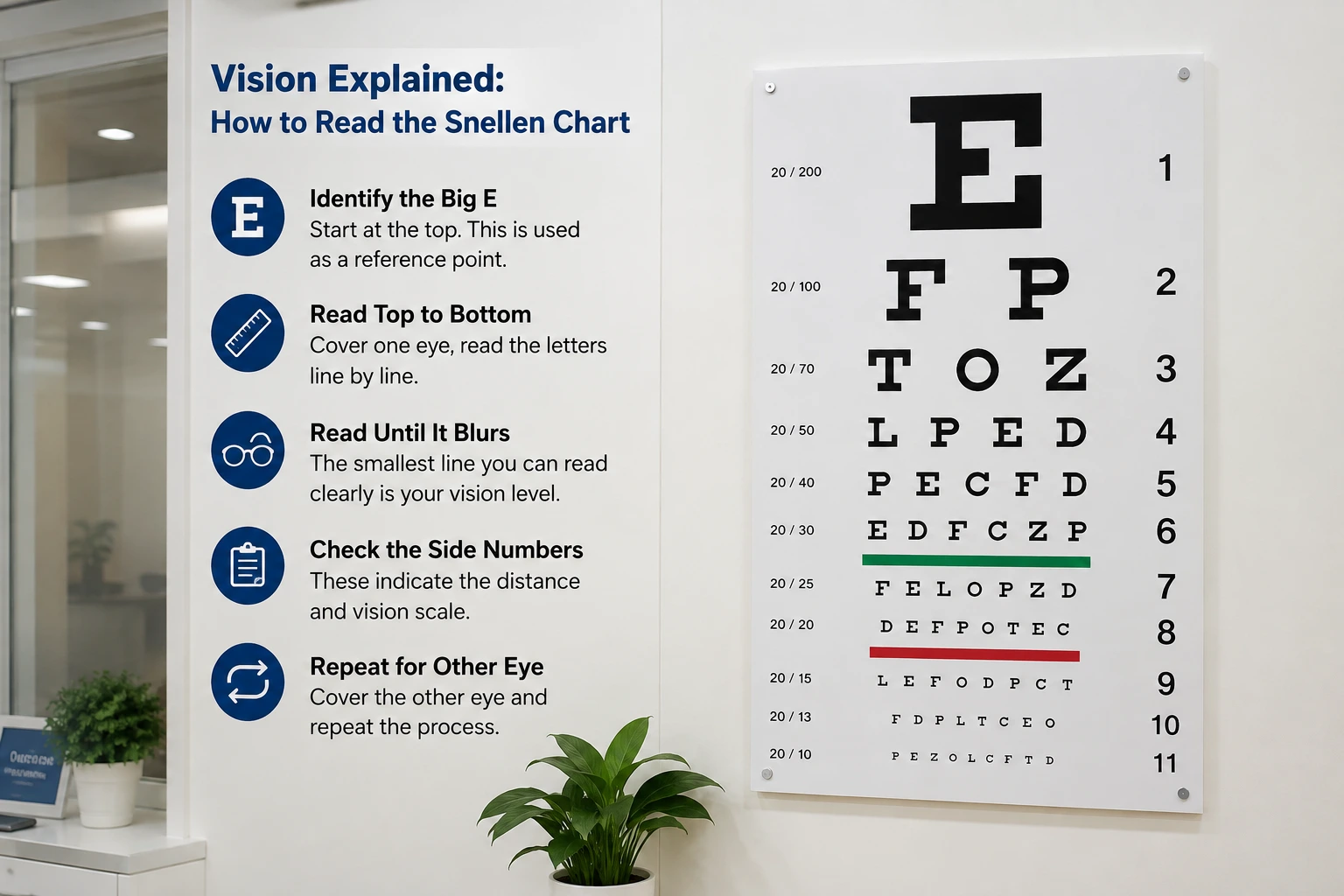
Have you ever walked out of an eye check-up holding a report that says “6/6” or “6/12” and wondered what it actually means for your eyesight? You are not alone. Most people see these numbers on a prescription slip and simply nod along, without understanding whether their vision is perfect, borderline, or a cause for concern.
This guide breaks down exactly how to read the Snellen chart, what 6/6 vision really means, why the test is still the gold standard for screening eyesight, and when it’s time to book an appointment with a qualified ophthalmologist. Whether you’re preparing for a routine check-up, a driving license eye test, or simply curious about your last report, this article will help you understand your numbers with confidence.
Interestingly, many people only start researching this topic after searching online for the Best Ophthalmologists Near Me in Pune, usually after noticing blurry vision or receiving a confusing report from a school or workplace screening.
In simple terms, 6/6 vision indicates that your eyesight is functioning within the normal range at that particular distance. It does not necessarily mean your vision is “perfect” in every sense — it is a benchmark of visual sharpness, or visual acuity, not a measure of color vision, depth perception, or peripheral vision.
1. Positioning: You are seated or made to stand at a fixed distance, typically 6 meters (about 20 feet) from the chart.
2. One Eye at a Time: One eye is covered while the other reads the letters aloud, starting from the top and moving down. This isolates the vision of each eye individually.
3. Reading the Rows: The chart has rows of letters that get progressively smaller from top to bottom. Each row corresponds to a specific acuity value.
4. Recording the Result: The smallest row you can read accurately without guessing determines your score, written as a fraction such as 6/6, 6/9, 6/12, and so on.
5. Repeat for the Other Eye: The same process is repeated for the second eye, and sometimes with both eyes open together to check binocular vision.
Numerator (top number): The fixed testing distance, usually 6 meters.
Denominator (bottom number): The distance at which a person with normal vision could read the same line.
So if your result is 6/12, it means you need to stand at 6 meters to read a line that someone with normal eyesight could read from 12 meters away. A smaller denominator, such as 6/6 or 6/5, indicates sharper vision, while a larger denominator, such as 6/18 or 6/24, indicates that your distance vision needs correction.
It’s worth remembering that even 6/6 vision is not automatically “flawless.” A person can have 6/6 vision and still experience issues like astigmatism, difficulty focusing on near objects, or reduced night vision, which is why a full eye examination goes far beyond just the Snellen test.
Myopia (nearsightedness): Difficulty reading distant letters clearly.
Hyperopia (farsightedness): Distance vision may appear normal, but near tasks feel strained.
Astigmatism: Letters may appear blurred, doubled, or distorted at multiple distances.
Amblyopia (lazy eye): A significant difference in acuity between the two eyes.
Early cataract changes: Gradual haziness or reduced contrast sensitivity, especially in older adults.
If your result is consistently below 6/9 or if one eye performs noticeably worse than the other, it is a strong signal to consult a specialist rather than dismissing it as a temporary issue.
This is especially true for older adults, since gradual acuity loss is often an early sign of cataracts. In such cases, getting evaluated by the Best Cataract Surgeon in Pune early on can make the difference between a simple corrective procedure and a more complicated surgery down the line.
This is exactly why the choice of clinic matters so much. Facilities recognized as the Best Eye Clinic in Pune typically go beyond the basic Snellen test, offering a full diagnostic workup so that nothing is missed during a routine visit.
Patients across the city frequently describe him as the Best Eye Specialist in Pune, largely because of his emphasis on combining traditional diagnostic tools with modern technology to catch problems early, long before they become serious.
1. Frequent headaches, especially after reading or screen time
2. Difficulty seeing road signs or the whiteboard from a distance
3. Squinting to focus on near or far objects
4. Sudden changes in vision clarity
5. A family history of glaucoma, cataracts, or macular degeneration
6. It has been more than a year since your last complete eye examination
Adults over 40 should ideally get their eyes examined annually, since this is the age range where conditions like presbyopia, cataracts, and glaucoma typically begin to develop.
For anyone typing “Eye Clinic Pune near me” into their search bar late at night after noticing blurry vision, know that timely evaluation can make a significant difference in how quickly a condition is managed and treated.
If you’ve been putting off your annual check-up, or if you’re simply unsure what your last prescription slip actually means, it’s worth reaching out to a trusted, Best Eye Hospital in Pune for a proper evaluation rather than relying on guesswork or outdated glasses.
Don’t wait for blurry vision to become a bigger problem. Schedule a comprehensive eye examination today and get personalized guidance on your results, your risk factors, and the right treatment plan for you.
And if surgical intervention is ever needed, whether for cataracts, refractive correction, or another condition, having an experienced Eye surgeon near me on hand ensures that follow-up visits and post-surgical care remain convenient and consistent. Your eyes deserve more than guesswork — book your appointment now and see the difference expert care makes.
This guide breaks down exactly how to read the Snellen chart, what 6/6 vision really means, why the test is still the gold standard for screening eyesight, and when it’s time to book an appointment with a qualified ophthalmologist. Whether you’re preparing for a routine check-up, a driving license eye test, or simply curious about your last report, this article will help you understand your numbers with confidence.
Interestingly, many people only start researching this topic after searching online for the Best Ophthalmologists Near Me in Pune, usually after noticing blurry vision or receiving a confusing report from a school or workplace screening.
What Is 6/6 Vision?
6/6 vision is the metric equivalent of what is commonly called “20/20 vision” in countries that use the imperial system. It means that a person can read a specific line of letters on a standardized eye chart from a distance of 6 meters, which is the same line that a person with normal vision would also read clearly from 6 meters.In simple terms, 6/6 vision indicates that your eyesight is functioning within the normal range at that particular distance. It does not necessarily mean your vision is “perfect” in every sense — it is a benchmark of visual sharpness, or visual acuity, not a measure of color vision, depth perception, or peripheral vision.
A Brief History of the Snellen Chart
The chart was developed in 1862 by Dutch ophthalmologist Hermann Snellen. It remains one of the most widely used tools in eye clinics across the world because it is simple, fast, and remarkably accurate for measuring central visual acuity. Despite newer digital and computerized vision tests being available today, the traditional Snellen chart continues to be a trusted first step in any comprehensive eye examination.How to Read the Snellen Chart: Step-by-Step
Understanding the mechanics of the test makes the results far less confusing. Here is exactly how the process works during a standard eye examination:1. Positioning: You are seated or made to stand at a fixed distance, typically 6 meters (about 20 feet) from the chart.
2. One Eye at a Time: One eye is covered while the other reads the letters aloud, starting from the top and moving down. This isolates the vision of each eye individually.
3. Reading the Rows: The chart has rows of letters that get progressively smaller from top to bottom. Each row corresponds to a specific acuity value.
4. Recording the Result: The smallest row you can read accurately without guessing determines your score, written as a fraction such as 6/6, 6/9, 6/12, and so on.
5. Repeat for the Other Eye: The same process is repeated for the second eye, and sometimes with both eyes open together to check binocular vision.
What Do the Numbers Actually Mean?
The Snellen fraction is often misunderstood, so let’s simplify it:Numerator (top number): The fixed testing distance, usually 6 meters.
Denominator (bottom number): The distance at which a person with normal vision could read the same line.
So if your result is 6/12, it means you need to stand at 6 meters to read a line that someone with normal eyesight could read from 12 meters away. A smaller denominator, such as 6/6 or 6/5, indicates sharper vision, while a larger denominator, such as 6/18 or 6/24, indicates that your distance vision needs correction.
It’s worth remembering that even 6/6 vision is not automatically “flawless.” A person can have 6/6 vision and still experience issues like astigmatism, difficulty focusing on near objects, or reduced night vision, which is why a full eye examination goes far beyond just the Snellen test.
Common Vision Problems the Test Can Reveal
While the Snellen chart is primarily used to detect refractive errors, an experienced eye doctor can often pick up early warning signs of the following during the same visit:Myopia (nearsightedness): Difficulty reading distant letters clearly.
Hyperopia (farsightedness): Distance vision may appear normal, but near tasks feel strained.
Astigmatism: Letters may appear blurred, doubled, or distorted at multiple distances.
Amblyopia (lazy eye): A significant difference in acuity between the two eyes.
Early cataract changes: Gradual haziness or reduced contrast sensitivity, especially in older adults.
If your result is consistently below 6/9 or if one eye performs noticeably worse than the other, it is a strong signal to consult a specialist rather than dismissing it as a temporary issue.
This is especially true for older adults, since gradual acuity loss is often an early sign of cataracts. In such cases, getting evaluated by the Best Cataract Surgeon in Pune early on can make the difference between a simple corrective procedure and a more complicated surgery down the line.
Why the Snellen Chart Alone Isn’t Enough
It’s important to understand that this chart only measures central distance vision. It does not evaluate eye pressure, retinal health, color blindness, or peripheral vision. That’s why routine screenings are usually paired with additional tests such as tonometry, fundus examination, and refraction testing during a complete eye check-up. This comprehensive approach is what separates a basic vision screening from genuine preventive eye care.This is exactly why the choice of clinic matters so much. Facilities recognized as the Best Eye Clinic in Pune typically go beyond the basic Snellen test, offering a full diagnostic workup so that nothing is missed during a routine visit.
Meet the Expert Behind This Guide
This article has been reviewed and explained with clinical insights from Dr. Ramesh Murthy, a senior ophthalmologist known for his patient-first approach to diagnosing and treating vision disorders. With years of experience managing everything from routine refractive errors to complex surgical cases, Dr. Murthy emphasizes that understanding your Snellen score is the first step toward taking your eye health seriously, not the last.Patients across the city frequently describe him as the Best Eye Specialist in Pune, largely because of his emphasis on combining traditional diagnostic tools with modern technology to catch problems early, long before they become serious.
Why Patients in Pune Trust This Clinic
When it comes to choosing where to get your eyes examined, the credibility of the clinic and the doctor matters just as much as the equipment used. Axis Eye Clinic has built its reputation on accurate diagnostics, transparent communication, and personalized treatment plans for every patient who walks through the door.When Should You Book an Eye Test?
You don’t need to wait for symptoms to worsen before scheduling a check-up. Consider booking a comprehensive eye exam if you notice any of the following:1. Frequent headaches, especially after reading or screen time
2. Difficulty seeing road signs or the whiteboard from a distance
3. Squinting to focus on near or far objects
4. Sudden changes in vision clarity
5. A family history of glaucoma, cataracts, or macular degeneration
6. It has been more than a year since your last complete eye examination
Adults over 40 should ideally get their eyes examined annually, since this is the age range where conditions like presbyopia, cataracts, and glaucoma typically begin to develop.
For anyone typing “Eye Clinic Pune near me” into their search bar late at night after noticing blurry vision, know that timely evaluation can make a significant difference in how quickly a condition is managed and treated.
Finding the Right Eye Care Team
Choosing where to go for your check-up shouldn’t be based on proximity alone. The most reliable way to decide is to look for a team of qualified, experienced doctors, transparent pricing, updated diagnostic equipment, and genuine patient reviews.If you’ve been putting off your annual check-up, or if you’re simply unsure what your last prescription slip actually means, it’s worth reaching out to a trusted, Best Eye Hospital in Pune for a proper evaluation rather than relying on guesswork or outdated glasses.
Frequently Asked Questions
1. Is 6/6 vision the same as 20/20 vision?
Yes. 6/6 is the metric measurement and 20/20 is the imperial measurement, but both represent the same standard of normal visual acuity.2. Can I have 6/6 vision and still need glasses?
Yes, in some cases. 6/6 vision only measures distance acuity. You may still need glasses for near work, astigmatism correction, or eye strain relief.3. How often should I get a Snellen chart test done?
Adults should get tested at least once a year, while children and older adults may need more frequent monitoring depending on risk factors.4. What does 6/18 vision mean?
It means you need to be at 6 meters to read what someone with normal vision reads at 18 meters, indicating noticeably reduced distance vision that likely requires correction.5. Can the Snellen chart detect all eye diseases?
No. It primarily measures visual acuity. Conditions like glaucoma or retinal disease require additional specialized tests during a complete eye examination.Book Your Eye Check-Up Today
Understanding your Snellen chart result is just the beginning of taking control of your eye health. Whether your last reading was a reassuring 6/6 or something that raised questions, the safest next step is a proper, in-person evaluation by an experienced professional.Don’t wait for blurry vision to become a bigger problem. Schedule a comprehensive eye examination today and get personalized guidance on your results, your risk factors, and the right treatment plan for you.
And if surgical intervention is ever needed, whether for cataracts, refractive correction, or another condition, having an experienced Eye surgeon near me on hand ensures that follow-up visits and post-surgical care remain convenient and consistent. Your eyes deserve more than guesswork — book your appointment now and see the difference expert care makes.