One moment your vision feels completely normal, and the next you notice a strange flicker of light or a cluster of floating specks drifting across your field of view. Most people brush this off as tiredness or eye strain. But in some cases, these small, easy-to-dismiss symptoms are the earliest warning signs of retinal detachment, a condition that can lead to permanent vision loss if not treated within hours to days.
This guide walks you through exactly what retinal detachment is, the specific symptoms that should never be ignored, who is most at risk, and what steps to take the moment you notice something unusual. If you or a loved one has ever experienced sudden flashes, floaters, or a shadow creeping across your vision, this article could help you protect your eyesight before it’s too late.
Once detached, the affected part of the retina stops functioning properly, and vision in that area becomes blurred, distorted, or completely lost. Because the retina cannot survive long without its blood supply, retinal detachment is considered a true ophthalmic emergency, not something to “wait and watch.”
1. Sudden Flashes of Light (Photopsia)
Brief flashes of light, especially noticeable in dim lighting or at the edges of your vision, often occur when the vitreous gel inside the eye tugs on the retina. While occasional flashes can be harmless, sudden and repeated flashing should always be evaluated promptly.
While retinal detachment can happen to anyone, certain groups face a considerably higher risk:
People with high myopia (severe nearsightedness)
Individuals who have had previous eye surgery, including cataract surgery
Those with a family history of retinal detachment
People who have experienced a significant eye injury or trauma
Patients with existing retinal thinning or lattice degeneration
Individuals over the age of 50, as the vitreous gel naturally changes with age
Diabetics with poorly controlled blood sugar are also at increased risk of a specific type called tractional retinal detachment, which develops due to abnormal blood vessel growth and scar tissue on the retina.
Rhegmatogenous detachment: The most common type, caused by a tear or hole that allows fluid to seep beneath the retina.
Tractional detachment: Occurs when scar tissue pulls the retina away from the back of the eye, often linked to diabetic eye disease.
Exudative detachment: Caused by fluid accumulating beneath the retina without any actual tear, often related to inflammation, injury, or other underlying disease.
Laser photocoagulation or cryopexy: Used for small tears before full detachment occurs, sealing the area to prevent fluid from spreading underneath.
Pneumatic retinopexy: A gas bubble is injected into the eye to help reposition the retina, often combined with laser or freezing treatment.
Scleral buckle surgery: A flexible band is placed around the eye to relieve tension on the retina, allowing it to reattach.
Vitrectomy: The vitreous gel is removed and replaced with a gas or oil bubble, commonly used for more complex or advanced detachments.
Choosing the right procedure requires precision and experience, which is why patients are often advised to consult the Best retina surgeon in Pune rather than opting for a general practitioner when facing this kind of emergency.
Sudden onset of new floaters or flashes of light
Any shadow or curtain effect in your vision, however small
Sudden blurring or distortion that doesn’t clear up
Vision changes following a recent eye injury or surgery
A history of retinal problems in one eye, with new symptoms developing in the other
If you’re unsure where to turn during such a moment, searching for the Best Eye Hospital in Pune with round-the-clock emergency ophthalmology services is a far safer choice than waiting until morning.
For patients simply researching where to go for their first consultation, the clinic is frequently recognized as the Best Eye Clinic in Pune, largely due to its emphasis on same-day evaluations for urgent visual symptoms rather than making patients wait for a routine appointment slot. Credentials, surgical volume, and patient outcomes matter far more than convenience or location when it comes to something as delicate as retinal surgery.
No. Retinal detachment is typically painless, which is exactly why the visual symptoms, flashes, floaters, and shadows, are so important to recognize early.
Q2. Can retinal detachment heal on its own?
No. It requires prompt medical or surgical treatment. Without intervention, it will not reattach on its own and vision loss will progress.
Q3. How quickly should I see a doctor if I notice symptoms?
Ideally within hours, and no later than the same day. The sooner treatment begins, the better the chances of preserving vision.
Q4. Can both eyes be affected by retinal detachment?
While it usually affects one eye at a time, having a detachment in one eye increases the risk of it occurring in the other eye as well, so regular monitoring is important.
Q5. Is surgery always required for retinal detachment?
In most cases, yes. The specific procedure depends on the type, size, and location of the detachment, which your doctor will determine after a detailed examination.
Reach out to an experienced eye surgeon near me today and get the urgent evaluation your eyes deserve. A quick phone call now could be the difference between a full recovery and irreversible damage. Book your emergency consultation today and protect the vision you c’t afford to lose.
This guide walks you through exactly what retinal detachment is, the specific symptoms that should never be ignored, who is most at risk, and what steps to take the moment you notice something unusual. If you or a loved one has ever experienced sudden flashes, floaters, or a shadow creeping across your vision, this article could help you protect your eyesight before it’s too late.
What Is Retinal Detachment?
The retina is a thin layer of light-sensitive tissue lining the back of the eye. It acts much like the film in a camera, capturing images and sending visual signals to the brain through the optic nerve. Retinal detachment occurs when this layer pulls away from the underlying tissue that supplies it with oxygen and nutrients.Once detached, the affected part of the retina stops functioning properly, and vision in that area becomes blurred, distorted, or completely lost. Because the retina cannot survive long without its blood supply, retinal detachment is considered a true ophthalmic emergency, not something to “wait and watch.”
Why Time Matters So Much
Unlike many other eye conditions that develop gradually, retinal detachment can progress rapidly, sometimes within a matter of hours. The longer the retina remains detached, the greater the risk of permanent damage to the light-sensing cells. Early-stage detachment, when only a small portion of the retina is affected, has a significantly higher chance of successful treatment and vision recovery compared to advanced cases where the macula, the part responsible for sharp central vision, has already become involved.Warning Signs You Should Never Ignore
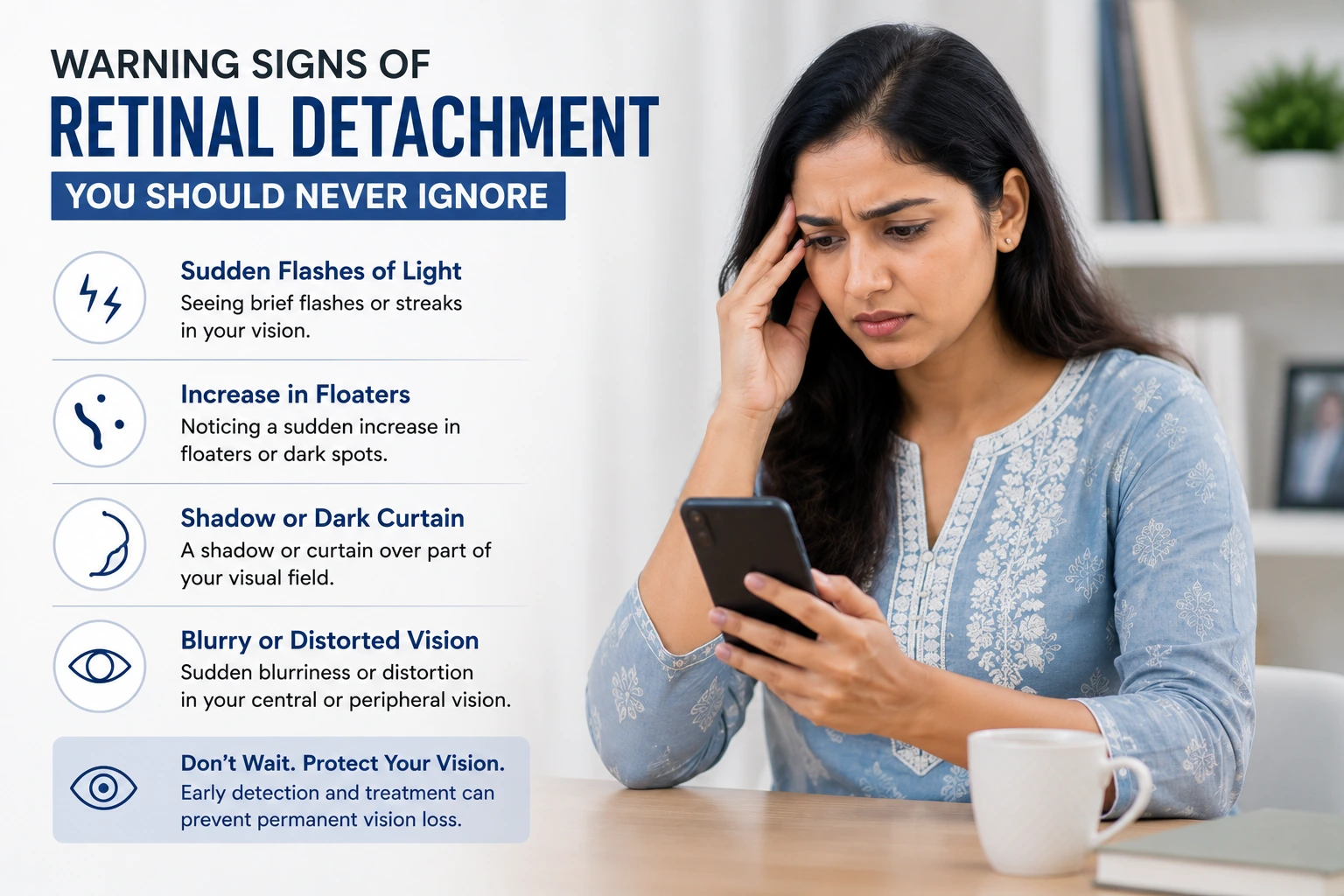
Recognizing symptoms early can make the difference between a full recovery and permanent vision loss. Here are the key warning signs to watch for: 1. Sudden Flashes of Light (Photopsia)
Brief flashes of light, especially noticeable in dim lighting or at the edges of your vision, often occur when the vitreous gel inside the eye tugs on the retina. While occasional flashes can be harmless, sudden and repeated flashing should always be evaluated promptly.
2. A Sudden Increase in Floaters
Floaters are tiny specks, cobwebs, or squiggly lines that drift across your vision. A few floaters are common and generally harmless, but a sudden shower of new floaters, especially if it happens all at once, can indicate that the retina is being pulled or torn.
3. A Shadow or Curtain Effect
One of the most alarming and unmistakable signs is the sensation of a dark curtain, veil, or shadow moving across part of your visual field. This typically starts at the edge of your vision and can spread inward if left untreated, signaling that a significant portion of the retina has already detached.
4. Blurred or Distorted Vision
Straight lines appearing wavy, or a general haziness that doesn’t improve with blinking, can be a sign that fluid has begun to collect beneath the retina.
5. Loss of Peripheral (Side) Vision
A gradual narrowing of your side vision, almost like looking through a tunnel, is another red flag that shouldn’t be dismissed as simple fatigue.
6. A Dark Shadow That Appears After an Injury
If any of these symptoms develop following a blow to the head or eye, a recent eye surgery, or an existing condition like severe nearsightedness, the urgency to get checked increases significantly.
If you notice even one of these symptoms, especially in combination, it’s essential to seek medical attention immediately rather than waiting to see if it resolves on its own.
Who Is Most at Risk?
While retinal detachment can happen to anyone, certain groups face a considerably higher risk:People with high myopia (severe nearsightedness)
Individuals who have had previous eye surgery, including cataract surgery
Those with a family history of retinal detachment
People who have experienced a significant eye injury or trauma
Patients with existing retinal thinning or lattice degeneration
Individuals over the age of 50, as the vitreous gel naturally changes with age
Diabetics with poorly controlled blood sugar are also at increased risk of a specific type called tractional retinal detachment, which develops due to abnormal blood vessel growth and scar tissue on the retina.
Types of Retinal Detachment
Understanding the type helps explain why treatment approaches differ from patient to patient:Rhegmatogenous detachment: The most common type, caused by a tear or hole that allows fluid to seep beneath the retina.
Tractional detachment: Occurs when scar tissue pulls the retina away from the back of the eye, often linked to diabetic eye disease.
Exudative detachment: Caused by fluid accumulating beneath the retina without any actual tear, often related to inflammation, injury, or other underlying disease.
What Happens If It’s Left Untreated?
Without timely intervention, a detached retina will almost always lead to worsening vision loss in the affected eye, and in advanced cases, complete and irreversible blindness. Even after successful surgical repair, delayed treatment can result in permanently reduced vision quality, particularly if the macula was involved before the procedure. This is precisely why recognizing symptoms early and acting quickly carries so much weight.How Is Retinal Detachment Diagnosed?
A comprehensive dilated eye examination is the standard first step, allowing the doctor to closely examine the retina for tears, holes, or areas of detachment. Additional imaging, such as ocular ultrasound or optical coherence tomography (OCT), may be used to assess the extent of detachment, particularly if the view is obscured by bleeding inside the eye. Getting evaluated promptly by an experienced retina specialist in Pune ensures that even subtle early changes are caught before they progress into a full detachment.Treatment Options for Retinal Detachment
Treatment depends on the type, size, and location of the detachment, but generally falls into a few categories:Laser photocoagulation or cryopexy: Used for small tears before full detachment occurs, sealing the area to prevent fluid from spreading underneath.
Pneumatic retinopexy: A gas bubble is injected into the eye to help reposition the retina, often combined with laser or freezing treatment.
Scleral buckle surgery: A flexible band is placed around the eye to relieve tension on the retina, allowing it to reattach.
Vitrectomy: The vitreous gel is removed and replaced with a gas or oil bubble, commonly used for more complex or advanced detachments.
Choosing the right procedure requires precision and experience, which is why patients are often advised to consult the Best retina surgeon in Pune rather than opting for a general practitioner when facing this kind of emergency.
Meet the Expert Behind This Guide
This article has been reviewed with clinical input from Dr. Ramesh Murthy, a senior ophthalmologist with extensive experience in diagnosing and managing complex retinal conditions. Widely regarded as the Best Eye Specialist in Pune by long-term patients, Dr. Murthy often reminds people that retinal detachment rarely announces itself loudly, which is exactly why understanding the subtle early symptoms matters so much for preserving long-term vision.Why Patients Trust This Clinic for Retinal Care
Choosing the right care team during a retinal emergency can be overwhelming, especially when every hour counts. Axis Eye Clinic has built a reputation for rapid diagnosis, advanced imaging technology, and a structured emergency protocol for suspected retinal detachment cases.When Should You Seek Immediate Care?
Certain situations call for same-day, or even same-hour, medical attention rather than scheduling a routine check-up:Sudden onset of new floaters or flashes of light
Any shadow or curtain effect in your vision, however small
Sudden blurring or distortion that doesn’t clear up
Vision changes following a recent eye injury or surgery
A history of retinal problems in one eye, with new symptoms developing in the other
If you’re unsure where to turn during such a moment, searching for the Best Eye Hospital in Pune with round-the-clock emergency ophthalmology services is a far safer choice than waiting until morning.
Finding the Right Specialist
Not every eye clinic is equipped to manage retinal emergencies, since this requires specialized training, surgical experience, and advanced diagnostic equipment. When evaluating your options, look for a team recognized among the Best Ophthalmologists Near Me in Pune, with dedicated retina services rather than general vision care alone.For patients simply researching where to go for their first consultation, the clinic is frequently recognized as the Best Eye Clinic in Pune, largely due to its emphasis on same-day evaluations for urgent visual symptoms rather than making patients wait for a routine appointment slot. Credentials, surgical volume, and patient outcomes matter far more than convenience or location when it comes to something as delicate as retinal surgery.
Frequently Asked Questions
Q1. Is retinal detachment painful?No. Retinal detachment is typically painless, which is exactly why the visual symptoms, flashes, floaters, and shadows, are so important to recognize early.
Q2. Can retinal detachment heal on its own?
No. It requires prompt medical or surgical treatment. Without intervention, it will not reattach on its own and vision loss will progress.
Q3. How quickly should I see a doctor if I notice symptoms?
Ideally within hours, and no later than the same day. The sooner treatment begins, the better the chances of preserving vision.
Q4. Can both eyes be affected by retinal detachment?
While it usually affects one eye at a time, having a detachment in one eye increases the risk of it occurring in the other eye as well, so regular monitoring is important.
Q5. Is surgery always required for retinal detachment?
In most cases, yes. The specific procedure depends on the type, size, and location of the detachment, which your doctor will determine after a detailed examination.
Don’t Wait Until It’s Too Late
Retinal detachment moves fast, and so should you. If you’ve noticed sudden flashes, an unusual increase in floaters, or any shadow creeping across your vision, don’t wait for the symptoms to pass on their own. Every hour of delay increases the risk of permanent vision loss.Reach out to an experienced eye surgeon near me today and get the urgent evaluation your eyes deserve. A quick phone call now could be the difference between a full recovery and irreversible damage. Book your emergency consultation today and protect the vision you c’t afford to lose.